We offer FREE SHIPPPING on all orders!
We offer FREE SHIPPPING on all orders!
| THIS PRODUCT IS INTENDED AS A RESEARCH CHEMICAL ONLY. This designation allows the use of research chemicals strictly for invitro testing and laboratory experimentation only. All product information available on this website is for educational purposes only. Bodily introduction of any kind into humans or animals is strictly prohibited by law. This product should only be handled by licensed, qualified professionals. This product is not a drug, food, or cosmetic and may not be misbranded, misused or mislabeled as a drug, food, or cosmetic. |
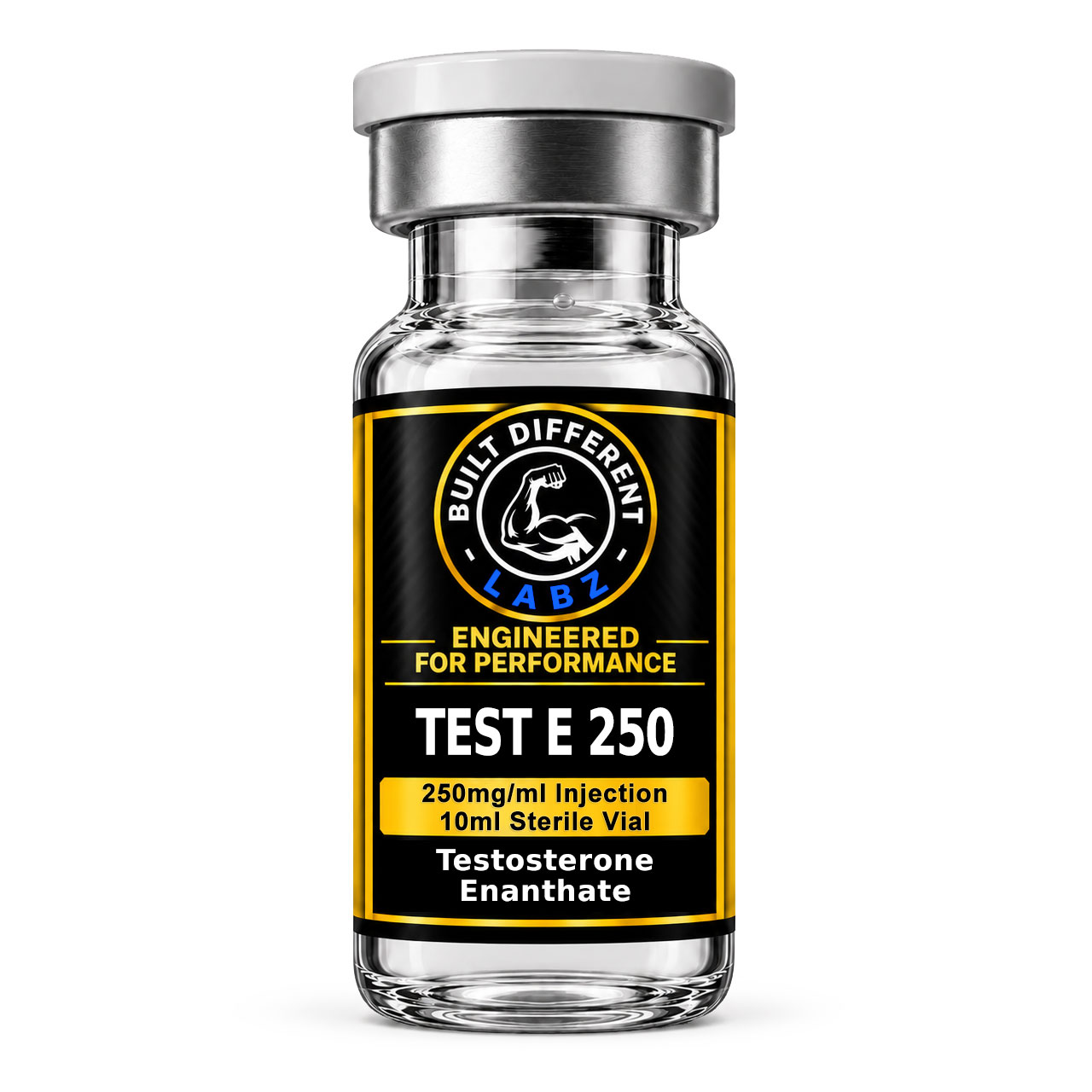
Testosterone Enanthate 250 is a long-acting injectable testosterone preparation commonly formulated to contain 250 mg of testosterone enanthate per milliliter. Testosterone enanthate is an esterified form of testosterone designed to release the hormone gradually following injection, providing a longer duration of action than unesterified testosterone or shorter esters such as testosterone propionate.
Testosterone enanthate consists of the natural hormone testosterone attached to an enanthate ester. The ester does not create a different type of testosterone once the compound becomes active. Instead, it primarily changes how quickly testosterone is released from the injection site and enters circulation.
After administration, testosterone enanthate forms a depot from which the compound is gradually released. Enzymes subsequently remove the enanthate ester, leaving biologically active testosterone.
Testosterone then interacts with androgen receptors throughout the body, including those found in skeletal muscle, bone, reproductive tissues, skin and the central nervous system.
A concentration of:
Testosterone Enanthate: 250 mg/mL
means that every milliliter of solution contains 250 mg of testosterone enanthate.
It is important to distinguish testosterone enanthate from free testosterone. The enanthate ester contributes part of the compound's molecular weight.
Testosterone enanthate is approximately 72% testosterone by molecular weight, meaning 250 mg of testosterone enanthate contains roughly 180 mg of testosterone, with the remainder representing the ester.
Once testosterone enters circulation, it binds to androgen receptors and influences gene transcription in responsive tissues.
Testosterone also follows two important metabolic pathways.
Aromatization: The aromatase enzyme converts a portion of testosterone into estradiol.
5-alpha reduction: The 5-alpha-reductase enzyme converts some testosterone into the more potent androgen dihydrotestosterone, or DHT.
Consequently, the effects of testosterone enanthate involve testosterone itself as well as downstream estradiol and DHT activity.
Testosterone enanthate is considered a long-acting testosterone ester.
Published pharmacokinetic estimates vary depending on how half-life is measured and the injection method, so there is not one universally applicable half-life number. Its practical characteristic is a considerably slower release than short esters such as testosterone propionate.
This prolonged release profile is one reason testosterone enanthate has historically been used for testosterone replacement.
Testosterone enanthate may be prescribed for certain forms of male hypogonadism, where inadequate endogenous testosterone production has been established clinically.
When testosterone deficiency is genuinely present, restoring testosterone toward an appropriate physiological range may improve symptoms or abnormalities involving:
The appropriate response varies between patients, and testosterone treatment is normally based on symptoms, medical evaluation and laboratory testing rather than a single testosterone measurement.
Testosterone has significant anabolic activity.
Androgen-receptor activation in skeletal muscle can promote protein synthesis and nitrogen retention and can contribute to increases in lean body mass and strength. Testosterone also affects muscle recovery and adaptation to resistance training.
However, medically restoring deficient testosterone and using supraphysiologic testosterone for bodybuilding or performance enhancement are very different situations.
Higher exposure can produce greater anabolic effects, but it can also substantially increase adverse effects. A product being an endogenous-hormone derivative does not make high-dose use physiologically equivalent to maintaining normal testosterone concentrations.
Testosterone enanthate and testosterone cypionate are extremely similar.
Both are long-acting testosterone esters, and after the ester is removed, both ultimately provide the same active hormone: testosterone.
The principal structural difference is the ester attached to testosterone. Enanthate contains a seven-carbon ester chain, while cypionate has an eight-carbon ester structure.
Cypionate is slightly heavier, which means enanthate provides marginally more testosterone per milligram of esterified compound. In practical clinical use, however, the differences between the two are relatively small.
Neither represents a fundamentally different anabolic hormone.
Testosterone propionate has a much shorter ester and therefore a shorter duration of action.
Enanthate remains available for considerably longer, whereas propionate produces a faster rise and decline in testosterone concentrations.
All three ultimately release testosterone. The major distinction is their pharmacokinetic profile rather than the identity of the active hormone.
Testosterone can be converted into estradiol through the aromatase enzyme.
Estradiol performs important physiological functions in men and contributes to bone health, sexual function and other processes. It should therefore not automatically be viewed as an unwanted side effect of testosterone.
Excessive testosterone exposure can nevertheless increase estradiol concentrations.
In susceptible individuals, increased estrogenic activity can contribute to:
Conversely, excessive suppression of estradiol can also cause significant problems. Using an aromatase inhibitor automatically alongside testosterone is therefore not equivalent to appropriately managing estrogen-related symptoms through clinical evaluation and laboratory testing.
Some testosterone is converted into dihydrotestosterone (DHT) through 5-alpha-reductase.
DHT is a potent androgen that has particularly important activity in tissues such as the skin, hair follicles and prostate.
Androgen-related effects can include:
Genetics strongly influence these effects. Two people exposed to similar testosterone concentrations can therefore experience substantially different androgenic side effects.
Exogenous testosterone suppresses the body's hypothalamic-pituitary-gonadal axis (HPG axis).
As circulating testosterone increases from an external source, the hypothalamus and pituitary reduce hormonal signaling to the testes. LH and FSH concentrations can consequently become very low.
The testes then decrease their own testosterone production.
This means testosterone enanthate should not be considered something that simply adds testosterone on top of normal endogenous production. Continued exposure can substantially suppress natural production.
The same suppression can have significant consequences for fertility.
Reduced FSH and intratesticular testosterone can dramatically decrease sperm production. Some men receiving exogenous testosterone develop very low sperm counts or azoospermia, meaning no sperm are detected in the ejaculate.
Testicular volume can also decrease.
Anyone interested in having children should specifically discuss fertility preservation with an appropriate clinician before beginning testosterone therapy.
Testosterone stimulates erythropoiesis, or red blood cell production.
Hemoglobin and hematocrit can consequently increase during testosterone therapy.
While this physiological effect is predictable, excessive increases in hematocrit can become medically important. This is one of the major reasons a complete blood count (CBC) is commonly monitored during testosterone treatment.
Testosterone's cardiovascular effects are complex and depend on the patient's health, dose, resulting hormone concentrations and duration of exposure.
Potential concerns can include:
Risk associated with medically supervised testosterone replacement should also be distinguished from supraphysiologic anabolic-steroid exposure. Evidence from appropriately treated hypogonadal patients cannot simply be assumed to establish the safety of much higher bodybuilding doses.
The prostate is androgen responsive.
Depending on age, medical history and individual risk, clinicians may consider prostate symptoms, PSA testing and other appropriate evaluations when initiating or monitoring testosterone treatment.
Testosterone therapy also requires particular medical consideration in someone with known or suspected prostate disease.
Possible adverse effects associated with testosterone enanthate include acne, oily skin, androgenic hair loss, increased body hair, gynecomastia, fluid retention, increased blood pressure, elevated hematocrit, changes in cholesterol, suppression of natural testosterone production, decreased sperm production, reduced fertility, testicular atrophy and injection-site reactions.
Testosterone can also worsen certain pre-existing conditions, including sleep apnea in susceptible individuals.
The probability and severity of adverse effects depend partly on the resulting testosterone exposure rather than simply the name of the ester.
Medical testosterone treatment generally involves ongoing clinical and laboratory monitoring.
Depending on the individual, clinicians may evaluate:
Total testosterone: Measures circulating testosterone.
Free testosterone and/or SHBG: May provide additional information when total testosterone does not adequately represent androgen status.
CBC / Hematocrit: Monitors increases in red blood cell concentration.
Blood pressure: Important because androgen therapy can affect fluid balance and cardiovascular risk factors.
PSA: May be appropriate depending on age and prostate risk.
Additional testing may be appropriate based on symptoms, medical history, cardiovascular risk and other medications.
The timing of testosterone testing relative to an injection is also important because serum concentrations fluctuate during the interval between injections.
A vial marked Testosterone Enanthate 250 mg/mL identifies its concentration.
It does not establish how much an individual should use.
An appropriate therapeutic regimen depends on the person's diagnosis, baseline testosterone concentrations, treatment response, laboratory results, age, medical history, fertility goals and other risk factors.
This distinction becomes especially important with concentrated injectable testosterone products because relatively small differences in injection volume can represent substantial differences in total drug exposure.
Compound: Testosterone Enanthate
Drug Class: Androgen / anabolic steroid
Active Hormone: Testosterone
Common Concentration: 250 mg/mL
Administration: Injectable
Ester: Enanthate
Release Profile: Long acting
Anabolic Activity: Yes
Androgenic Activity: Yes
Aromatizes to Estrogen: Yes
Converts to DHT: Yes
Suppresses Natural Testosterone Production: Yes
Can Suppress Fertility: Yes
Primary Medical Application: Testosterone replacement for appropriately diagnosed testosterone deficiency
Testosterone enanthate is one of the most established long-acting forms of injectable testosterone. The enanthate ester primarily controls the hormone's release rate; once that ester is removed, the resulting testosterone is the same hormone naturally produced by the human body.
Its physiological effects extend considerably beyond muscle growth. Testosterone influences muscle, bone, sexual and reproductive function, estrogen and DHT production, red blood cell formation, fertility and several cardiovascular risk factors.
For that reason, testosterone enanthate is best understood as a systemically active hormone medication rather than simply a muscle-building compound. When medically indicated, appropriate laboratory testing and ongoing clinical monitoring are important parts of its use.
We do not accept returns or issue refunds for any reason, beside manufacturing defects.
Feel free to contact us if you have any questions or concerns about our Return Policy.