We offer FREE SHIPPPING on all orders!
We offer FREE SHIPPPING on all orders!
| THIS PRODUCT IS INTENDED AS A RESEARCH CHEMICAL ONLY. This designation allows the use of research chemicals strictly for invitro testing and laboratory experimentation only. All product information available on this website is for educational purposes only. Bodily introduction of any kind into humans or animals is strictly prohibited by law. This product should only be handled by licensed, qualified professionals. This product is not a drug, food, or cosmetic and may not be misbranded, misused or mislabeled as a drug, food, or cosmetic. |
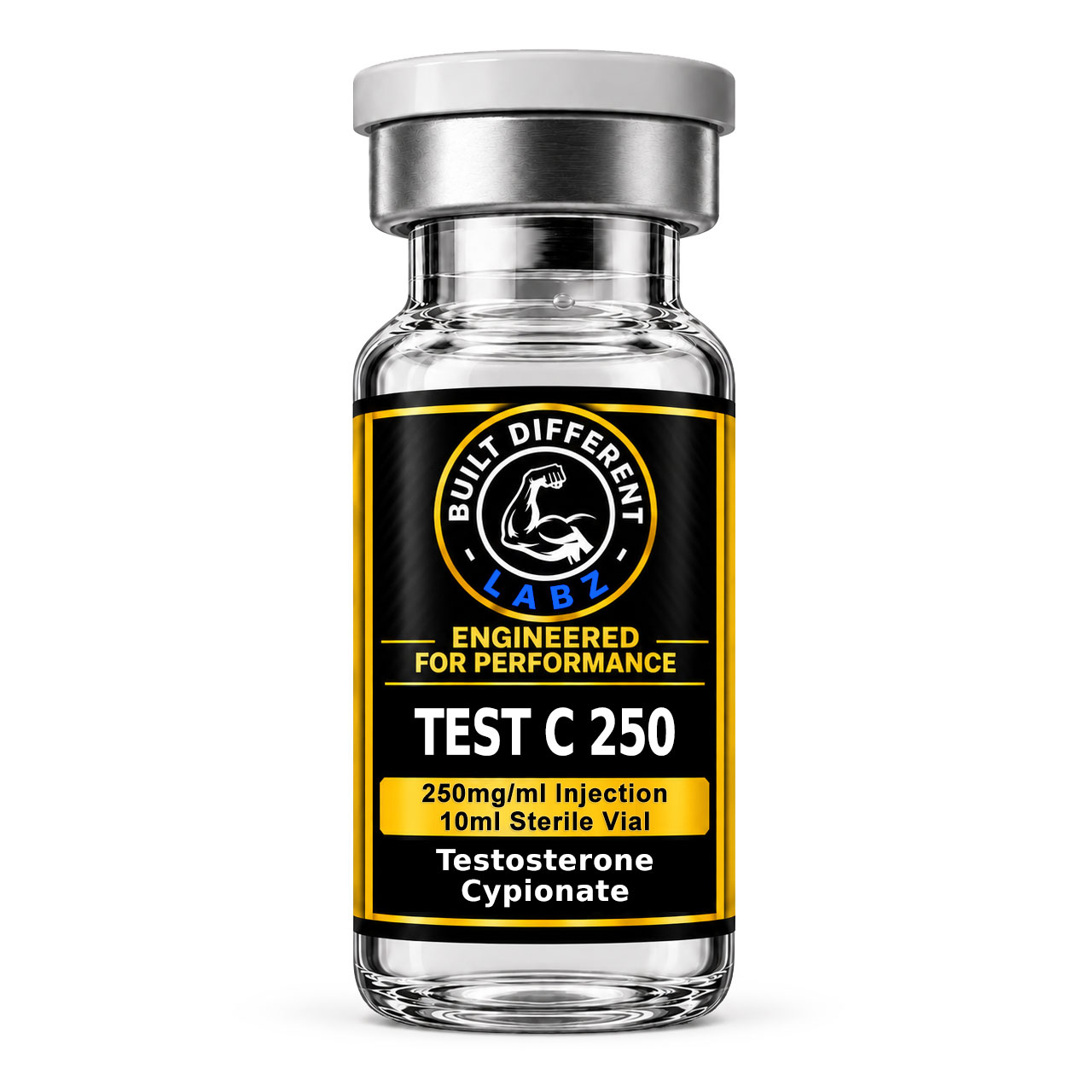
Testosterone Cypionate 250 is an injectable preparation containing 250 mg of testosterone cypionate per milliliter. Testosterone cypionate is a long-acting ester of testosterone designed to release testosterone gradually after an intramuscular injection. In legitimate medical care, testosterone products may be prescribed for certain forms of testosterone deficiency, with treatment individualized and monitored by a clinician.
Testosterone is the primary androgenic sex hormone in males and plays an important role in numerous physiological processes, including the development and maintenance of male sexual characteristics, reproductive function, muscle and bone physiology, red blood cell production, and sexual function.
In testosterone cypionate, the testosterone molecule is attached to a cypionate ester. This ester slows the release of testosterone from the injection site. After entering circulation, the ester is cleaved and active testosterone becomes available to tissues.
Because of this extended-release behavior, testosterone cypionate remains in the body substantially longer than unesterified testosterone. Its commonly cited intramuscular half-life is approximately eight days, although actual concentrations and effects vary considerably among individuals.
The "250" generally refers to a concentration of:
Testosterone Cypionate: 250 mg/mL
It describes the amount of esterified testosterone contained in each milliliter of solution. Importantly, 250 mg of testosterone cypionate is not equivalent to 250 mg of free testosterone because part of the molecular weight comes from the cypionate ester.
Testosterone cypionate is approximately 70% testosterone by molecular weight, so 250 mg of testosterone cypionate contains roughly 175 mg of testosterone before considering pharmacokinetic factors.
Once administered, testosterone cypionate forms a depot at the injection site. The compound is gradually released, enters circulation, and is converted to biologically active testosterone.
Testosterone binds to androgen receptors throughout the body. These receptors are present in skeletal muscle, bone, reproductive tissues, the central nervous system, skin and numerous other tissues.
Testosterone can also undergo two important metabolic conversions. Aromatase can convert testosterone into estradiol, while 5-alpha-reductase can convert testosterone into dihydrotestosterone (DHT). Estradiol and DHT have their own physiological effects, which helps explain why changing testosterone concentrations can affect many systems beyond muscle tissue.
For a person with clinically confirmed testosterone deficiency for whom testosterone therapy is appropriate, restoring testosterone toward a physiological range can potentially improve symptoms associated with that deficiency. Depending on the individual, these can include sexual function, libido, lean body mass, bone density and certain aspects of well-being.
Testosterone is also strongly anabolic. Activation of androgen receptors in skeletal muscle can support protein synthesis and maintenance of lean tissue. However, the presence of anabolic effects does not mean that progressively higher testosterone concentrations provide progressively greater health benefits.
Medical testosterone replacement and supraphysiologic anabolic-steroid use are therefore different situations and have different risk profiles.
Cypionate and enanthate are closely related long-acting testosterone esters. Their pharmacological characteristics overlap substantially, and both ultimately provide the same active hormone: testosterone.
The ester structure and pharmacokinetics differ somewhat, but in clinical practice the differences are generally much smaller than the difference between either compound and a short-acting testosterone formulation.
Testosterone propionate uses a considerably shorter ester. It is released and eliminated more rapidly and therefore produces a different concentration-time profile.
Cypionate's longer duration is one reason it is commonly used when a longer-acting injectable testosterone formulation is desired.
Testosterone has genuine anabolic effects. Higher androgen exposure can increase nitrogen retention, protein synthesis, lean body mass and strength, particularly when combined with resistance training and adequate nutrition.
However, doses intended to produce testosterone concentrations substantially above normal physiological levels are not equivalent to testosterone-replacement therapy. Increasing exposure can also increase adverse effects involving cardiovascular risk factors, blood pressure, hematocrit, lipids, fertility and other systems.
Some testosterone is naturally converted to estradiol through aromatase.
Estradiol is not simply an unwanted byproduct in men. Appropriate estrogen signaling contributes to bone health, sexual function and other physiological processes.
Excessive androgen exposure can nevertheless increase estradiol production. In susceptible individuals, elevated estrogenic activity may contribute to breast-tissue enlargement or tenderness and fluid retention.
Conversely, unnecessarily suppressing estradiol can also cause problems. This is why automatically adding an aromatase inhibitor solely because someone uses testosterone is not a sound substitute for symptoms, laboratory testing and medical evaluation.
Testosterone can also be converted into dihydrotestosterone (DHT).
DHT is a potent androgen involved in tissues such as the skin, hair follicles and prostate. Increased androgen exposure can therefore contribute to acne, oily skin, increased body or facial hair, and accelerated male-pattern hair loss in genetically susceptible individuals.
Exogenous testosterone suppresses the hypothalamic-pituitary-gonadal axis.
When testosterone is supplied externally, the hypothalamus and pituitary typically reduce GnRH, LH and FSH signaling. Consequently, the testes reduce endogenous testosterone production and sperm production.
This means testosterone therapy can substantially reduce fertility. Some men can develop very low sperm counts or azoospermia while receiving exogenous testosterone. Testicular volume may also decrease.
Anyone who wants to preserve or establish fertility should discuss this specifically with a qualified clinician before beginning testosterone therapy rather than assuming fertility will remain unaffected.
Testosterone stimulates erythropoiesis, meaning it can increase red blood cell production.
That can raise hemoglobin and hematocrit. An excessive hematocrit increase is one of the important complications clinicians monitor during testosterone therapy because increased blood viscosity can become medically significant.
A CBC is therefore commonly part of medical monitoring.
Testosterone's cardiovascular effects depend on the individual, underlying health, dosage, resulting hormone concentrations and other risk factors.
Potential concerns include increases in blood pressure, changes in cholesterol-particularly reductions in HDL in some circumstances-fluid retention, increased hematocrit and possible worsening of pre-existing cardiovascular risk factors.
The risks associated with medically supervised replacement that maintains physiological testosterone concentrations should not automatically be extrapolated to high-dose anabolic-steroid use, and vice versa.
Androgens influence prostate tissue. Testosterone treatment requires particular consideration in men with prostate disease or certain prostate-cancer risks.
Clinicians may assess prostate-related history and, when appropriate for a patient's age and circumstances, PSA and other prostate evaluations before or during therapy.
Potential adverse effects associated with testosterone cypionate include:
Individual responses vary significantly.
Testosterone treatment should not be managed solely by how someone feels. Appropriate clinical monitoring can include total testosterone, sometimes free testosterone or SHBG, CBC/hematocrit, blood pressure, and other testing based on the person's medical history and risk factors. Fertility, prostate health, cardiovascular risk and treatment-related symptoms may also require assessment.
Timing matters when interpreting testosterone bloodwork because concentrations fluctuate during the interval between injections. A clinician therefore needs to know when the blood sample was collected relative to the injection.
A bottle labeled 250 mg/mL describes a concentration, not an appropriate dose.
The medically appropriate amount and frequency depend on the diagnosis, laboratory results, symptoms, treatment goals, age, other medications, cardiovascular risk, fertility plans and individual pharmacokinetics. Two people using the same product concentration may appropriately receive very different treatment regimens.
Compound: Testosterone Cypionate
Drug class: Androgen / anabolic steroid
Active hormone: Testosterone
Common concentration: 250 mg/mL
Administration: Injectable
Ester: Cypionate
Release profile: Long acting
Approximate IM half-life: About 8 days
Aromatizes to estrogen: Yes
Converts to DHT: Yes
Suppresses endogenous testosterone: Yes
Can suppress sperm production: Yes
Primary legitimate use: Testosterone replacement in appropriately diagnosed patients
Testosterone cypionate is a well-established long-acting testosterone preparation, but its effects extend far beyond muscle growth. Testosterone influences reproductive, cardiovascular, hematologic, skeletal, sexual and endocrine physiology, making proper diagnosis, dosing and ongoing medical monitoring particularly important.
We do not accept returns or issue refunds for any reason, beside manufacturing defects.
Feel free to contact us if you have any questions or concerns about our Return Policy.